Which Careers Are Growing as AI Agents Take Over Tasks
Agents absorb routine tasks while builders, overseers, and strategists gain ground.
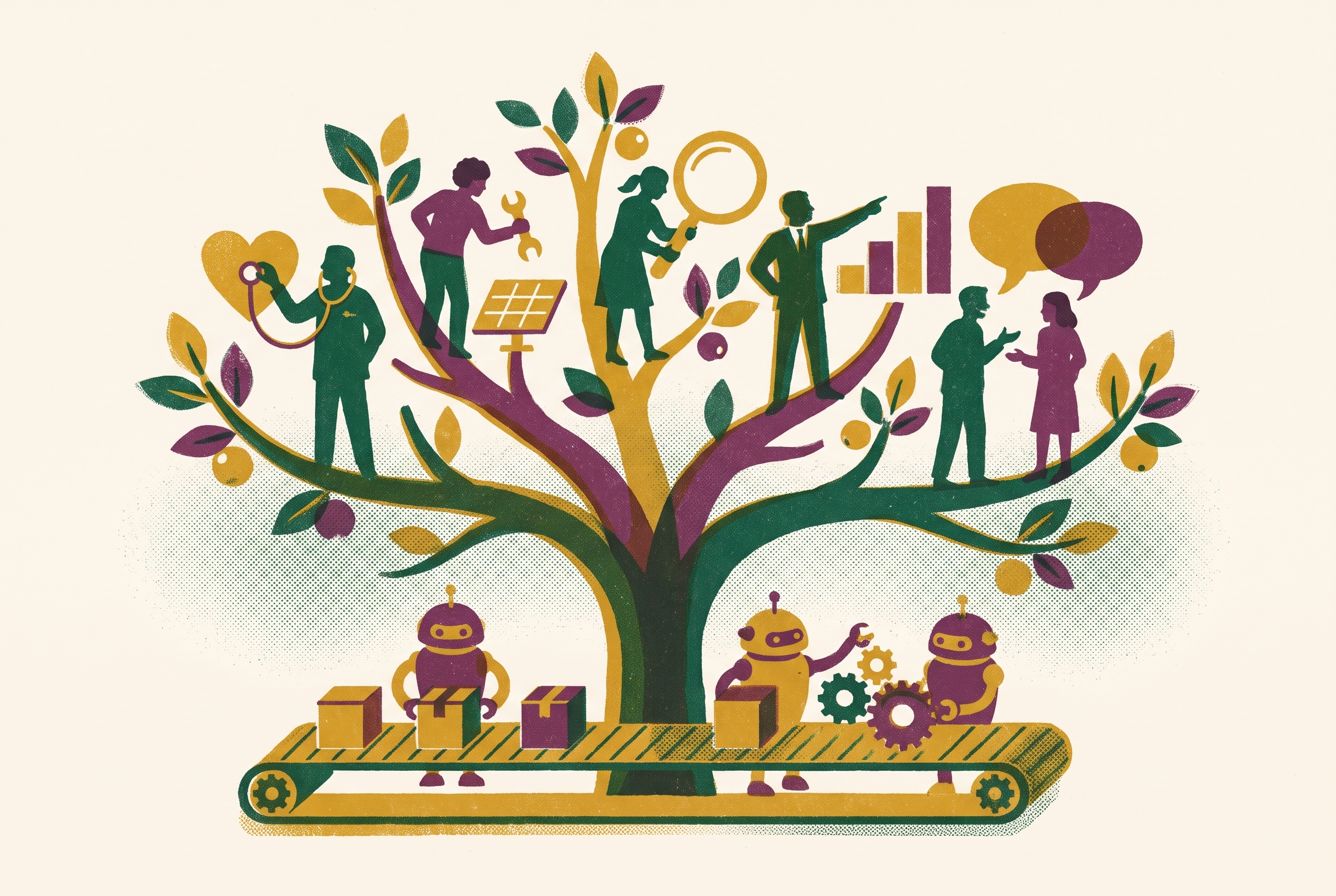
AI agents are changing careers by absorbing repeatable tasks and increasing demand for people who build, direct, and oversee their work. The work inside a role offers the clearest guide to your next move. Careers built around judgment, accountability, and human relationships sit on the stronger side of that shift.
Why agents restructure tasks before they restructure headcounts
Agents absorb parts of a job before they change how many people a company needs. Unlike automation scripts, they can plan, reason, and carry out multistep tasks without a person telling them what to do at each step. That changes the scope of work they can take on. A task no longer needs to consist of one fixed action to become a candidate for automation.
Companies use agents for data entry, FAQ responses, basic coding, and document sorting. They then move people toward supervision, exception handling, client relationships, and strategy. The division of work changes within the role. Someone who once did routine work may spend more time checking whether that work is sound and dealing with unusual cases.
The entry-level layer feels this pressure first because routine work has also served as training. Drafting basic reports, writing boilerplate code, and summarizing meetings gave junior employees ways to learn. Agents now handle many of those tasks. That compresses the traditional route toward senior work, even when a company still needs experienced people to exercise judgment.
Asking only which jobs disappear overlooks changes that happen before a title vanishes or a team gets smaller. A role can remain while its daily work changes substantially. Its prospects depend partly on how much human responsibility remains after agents take over the repeatable parts.
Which roles are most exposed to agents, and why
The most exposed roles involve screen-based, text-heavy, rule-driven work with limited physical or social judgment. BCG’s 2026 framework identifies exposure across administrative support, customer support, basic writing, junior software, basic finance, and routine legal work. These fields have different purposes but share a pattern. Much of their routine output follows instructions that agents can interpret and act on.
People in office and administrative support do data entry, set schedules, and sort documents. Customer support and call centers face similar pressure around routine queries and ticket triage. The distinction sits between processing a familiar request and deciding what to do when that request needs human judgment.
Basic content writing faces pressure around product descriptions, standard ad copy, and boilerplate reports. In junior software roles, tasks at risk include writing boilerplate code, fixing bugs, and building simple features. People doing basic finance work write standard reports and make decisions based on rules. For legal assistants and paralegals, the work at risk is document review, basic research, and routine drafting, which are only some parts of legal work.
Entry-level white-collar roles are under particular pressure when almost all their tasks are routine. Work-from-home arrangements also meant much of that work was already digitally legible to agents. The hiring effect can precede visible team cuts. One senior person who directs agents can do work that once needed a small junior team, so companies hire fewer new entry-level staff.
Physical trades, clinical healthcare, licensed high-accountability roles, and emergency and field services resist this pattern. Their work needs people who are there in person, can work in unstructured environments, or make judgments under rules that agents still cannot match. Resistance rests on what the work demands, rather than an assumption that agents will stop improving.
The three tiers of roles that are growing
Demand is growing for people who build agent systems, oversee their behavior, and decide where to use them. LinkedIn’s January 2026 analysis found that AI had already added millions of new roles. Among these were AI engineer, forward-deployed engineer, and data annotator roles, as well as AI-enabled data center jobs. AI engineer was the fastest-growing U.S. job title for the second year in a row.
The World Economic Forum’s Future of Jobs Report projects substantially more roles created by 2030 than displaced. It places AI and machine learning specialists among the three fastest-growing occupations worldwide. Growth and displacement can happen at the same time. The emerging work falls into three useful tiers, namely builders, overseers, and strategists.
Builders construct the systems that let agents do useful work in a particular setting. A forward-deployed engineer works inside a customer organization to build and tune agent workflows for its specific technology stack. Palantir originated the role, and OpenAI, Anthropic, and Google are actively hiring for it. The job connects engineering with a customer’s actual work.
Other builder roles focus on the conditions that make agent performance dependable. A context engineer designs retrieval pipelines, memory systems, and information flows for multistep tasks. An AI agent architect designs systems in which multiple agents coordinate tools and complex actions. Both roles shape how the work gets done. Their focus extends beyond generating a single response.
An AI evals engineer builds test suites that catch hallucinations, regressions, and bias before they reach users. Models can drift with every update, so evaluation becomes a lasting discipline. Builders need ways to tell when an update changes how a system behaves or makes a result they once accepted less reliable.
Overseers are in charge of agents once their work starts to shape real decisions. An agent supervisor or handler watches agents work, approves high-stakes actions, and intervenes when an agent enters a reasoning loop. This role keeps a person involved at consequential points. Its central skill is knowing when the agent can proceed and when human judgment must take over.
An agent compliance and audit specialist checks behavior against obligations and standards including GDPR, the EU AI Act, and SOC 2. An AI governance and ethics lead focuses on transparency, accountability, and regulation. These jobs put human responsibility around systems that can act with less direct instruction.
Quality oversight also needs a clear standard for acceptable performance. An AI evals and quality lead builds benchmark harnesses and scoring rubrics to judge whether an agent is production-ready. An auditor reviews agent decision logs, traces hallucination chains, and certifies audit trails. The work demands careful interpretation of evidence. Producing a result and approving its use are distinct responsibilities.
Strategists decide which work agents should do and how organizations should adopt them. An AI agent product manager owns the roadmap, defines success metrics, and decides which workflows to automate first. That role decides what comes first before builders start the work. It connects what an agent can do with what a business needs it to accomplish.
A chief AI officer is in charge of AI strategy and its ethical rollout across the company, while smaller firms can hire fractional chief AI officers. An AI transformation lead guides how the company takes up AI and measures its return on investment. These roles treat agent use as an organizational decision. Technical capability is one part of that decision.
A human-AI collaboration lead designs workflows, training programs, and interfaces for people working with agents. This adds another kind of judgment to the strategist tier. Someone must decide how responsibilities fit together, including where people supervise and where they intervene. Across all three tiers, technical fluency gains value when paired with domain knowledge and clear responsibility.
How the curator shift is spreading across non-technical fields
The move from producing output to directing and evaluating it also reaches people outside engineering. When agents generate or process work, practitioners take on more responsibility for specifying, selecting, and refining the result. This is the curator shift. Its value comes from knowing what good work looks like in a particular field.
Graphic designers are moving toward art direction. Image-generation pipelines increase the volume of possible output, while designers decide what is right for the work. Production and selection become more distinct responsibilities. People increasingly set the direction and judge how well the results follow it, while doing less of the work of making each element by hand.
Copywriters face a related shift toward prompt orchestration and brand voice editing. Their craft moves toward specifying, evaluating, and refining output at scale. Drafting remains part of the work, but its share changes. The judgment involved in deciding whether language fits a brand becomes more prominent as agents produce more of the initial text.
Customer success and sales show why this pattern extends beyond creative work. Agents handle routine queries and outreach cadences, while people focus on escalation, negotiation, and trust-building. The relationship layer becomes a larger share of the role. People bring value when a standard response falls short of meeting the customer's needs.
Operations and HR generalists apply the same logic to business processes. Their work shifts toward designing processes and translating them into clear logic that agents can execute reliably. Process design depends on understanding both the normal sequence and the exceptions that need human attention.
The skills behind these changes extend across fields. Advanced agent orchestration and prompt engineering sit with process design, critical thinking, governance, risk reasoning, and systems thinking. Many build on strengths in project management, operations, and people leadership. Technical retraining is only part of the picture. The growing roles also need people who can organize work and judge its consequences.
AI fluency increasingly serves as a baseline expectation. Claiming familiarity with tools says less than showing which tools someone has actually shipped with. That distinction connects general skills to evidence of applied work. For people in product, design, marketing, sales, and operations, the question becomes how their existing judgment works through these tools.
What this means for where to move next, and how the matching problem has changed
Your next move depends more on a role’s task mix than on whether its title sounds current. The same title can describe mostly routine production in one team and substantial judgment in another. How much involves repeatable output, and how much involves oversight, exceptions, relationships, or decisions about what happens next?
If your work falls into a high-exposure category, the next step need not mean leaving your field. Identify where judgment and oversight sit within it, then move toward that layer deliberately. Your domain knowledge can support that transition. Entry-level compression makes that path harder because you have fewer routine tasks to learn from.
Finding that next role also calls for a better kind of matching. Keyword systems struggle to capture what someone does well and what a team actually needs. Agents offer a way to consider that nuance. A candidate-side agent can focus on strengths and preferences, then seek a next step that may not be the most visible opening.
The hiring side faces the same problem. Startups and scale-ups filling overseer and strategist roles need to understand what someone has shipped and what the team needs next. Volume-based sourcing can miss that fit. A familiar title or matching keyword may reveal less than the responsibilities someone has already handled.
For people already in high-demand work, a well-matched introduction can be more relevant than a cold application. That gives career matching a different purpose from generating more applications. The opportunity is to connect demonstrated strengths with work that needs them. As agents absorb tasks, the next move becomes a search for where your judgment can do the most useful work.
Every new piece from The Hiring Shift, as it's published.
Follow